Showing posts with label social history. Show all posts

Friday, December 9, 2011

Rabbit stew

As a child, I ate a lot of rabbit stew. The meat was free, and properly cooked, it's delicious. Rabbit meat is virtually fat-free, and therefore a healthy source of protein.
Any chicken casserole recipe can be adapted to use rabbit instead, if you're lucky enough to find a source.
Before cooking your rabbit, there's a couple of things you need to understand.
Rabits are muscular little creatures, and the meat needs long slow cooking to tenderise it. And it can be a bit gamey, so soaking it first is a good idea.
This is how Mum prepared rabbit stew.

Cut the rabbit into portions, and soak in cold, salted water, for at least an hour.
Dry the meat, and brown it in a frying pan. Remove and place in a heavy pot.

Then fry a roughly chopped onion and several rashers of bacon in the frypan. Add these to the pot with the rabbit. Pour some hot water into the frypan, and scrape up all the brown bits. Pour this water over the rabbit in the pot, and add a pinch of mixed herbs and two or three thickly sliced carrots.
Cover and simmer gently for about 1 + 1/2 hours, or until the meat is tender - will depend on the age of the bunny.
Remove the meat to a plate, and thicken the gravy with flour, and a dash of Parisian essence if liked.
Serve with mashed potatoes and peas or beans.

Parisian essence was a browning agent, made, I think, from caramelized sugar. You probably can't buy it now. Today I would use Gravox as a thickener. Sliced celery would be a good addition, and a  slurp of red wine would also go well.


A bit of history (from Wikipedia)
Everyone blames Thomas Austin for the rabbit problem in Australia. He released 12 wild rabbits, specially imported from England, on his property, Barwon Park, near Winchelsea, Victoria, in October 1859 for hunting purposes. Many other farms released their rabbits into the wild after Austin. At the time he had stated, "The introduction of a few rabbits could do little harm and might provide a touch of home, in addition to a spot of hunting."[5] 

Aussies have been hunting them ever since!

But rabbits were first introduced to Australia by the First Fleet in 1788. They were bred as food animals, probably in cages. In the first decades they do not appear to have been numerous, judging from their absence from archaeological collections of early colonial food remains.
However, by 1827 in Tasmania a newspaper article noted ‘…the common rabbit is becoming so numerous throughout the colony, that they are running about on some large estates by thousands. We understand, that there are no rabbits whatever in the elder colony' [i.e. New South Wales][2]. This clearly shows that a localised rabbit population explosion was underway in Tasmania in the early 19th century. At the same time in NSW Cunningham noted that '... rabbits are bred around houses, but we have yet no wild ones in enclosures...’ He noted that the scrubby, sandy soil between Sydney and Botany Bay would be ideal for farming rabbits[3]. Enclosures appears to mean more extensive rabbit-farming warrens, rather than cages. The first of these, in Sydney at least, was one built by Alexander Macleay at Elizabeth Bay House,'a preserve or rabbit-warren, surrounded by a substantial stone wall, and well stocked with that choice game'[4]. In the 1840s rabbit-keeping became even more common, with examples of the theft of rabbits from ordinary peoples' houses appearing in court records, and rabbits entering the diet of ordinary people.

So rabbit has been an integral part of Australian cuisine since the first white settlement. Many a farmer has cursed them, and they have caused untold damage to the environment and the economy. Still, they're damn good eating!

Saturday, November 5, 2011

Bachelors and Spinsters


After the death of their mother, Annie and her sister Eileen lived at the farm in Minyip, keeping house for their father and younger brother Jack. There was plenty to do; housekeeping without electricity is no easy job – no vacuum cleaners, washing machines or refrigerators. Cooking was done on a wood-fired stove. At haymaking and harvesting time there would often be extra men to feed – and they expected hot dinners, too!
Outside the house there were poultry to feed, cows to milk, and gardens to tend. Most people were as self-sufficient as possible, making butter, preserving fruit and growing vegies.
 You might think that life in a small country town would be pretty quiet – dull, even. But you’d be wrong. Country people are pretty good at entertaining themselves! Annie and Eileen had a very busy social life. Perusal of the local newspapers of the time show that there were plenty of social events - a kitchen tea, a concert, a card night, a twenty-first birthday party.
There was plenty of sport for those so inclined: football, golf, tennis and cricket. Lavish afternoon teas and suppers were the norm.
Mum used to tell the story of a school friend from Ballarat, who came to stay on the farm for several weeks, and Annie and Eily did their best to show her a good time. When the lass returned home, she spent several weeks in bed, suffering from “nervous exhaustion”!

By the late twenties, most people had a car; the Mahers had a Ford, a ‘tin Lizzie’ and it went everywhere, over the roughest of roads, and even across paddocks. Their next car was an Essex, followed by a Chev.
Every little community for miles around had at least one Ball; Bachelors and Spinsters Balls were all the rage (not the drunken affairs we hear of nowadays) and people drove a long way to attend them.
One the way home from one such occasion, in wet weather (the main ball season was winter) the car skidded on the greasy road (I’m talking here about an unsealed road which consisted of two wheel tracks with a grassy centre – you can still see a few tracks like that in the Wimmera - and landed in the table drain (wide shallow drain at the side of the road). They were hopelessly bogged, and had to trudge across the paddocks in full evening finery - long dresses for the girls - to the nearest house where they stayed the rest of the night. It was not uncommon for them to return home early in the morning, when the boys would milk the cows and then go to bed.

Everyone had dance programmes, with a little pencil attached, so the boys could book dances. 
When Mum died, we found a few of them among her keepsakes. 
In this one, the writing is my father’s, and I wondered why it had been kept for so long. The date was July 15th, 1927, and Fred had four dances with Ann. 
She would have been just 19, Fred a couple of years older. What happened that night that caused one of them to keep the dance programme for all those years?

Over the next years, Annie had several boyfriends, but they all fell by the wayside; in a couple of cases, Mum said, because they were drank too much, and there was No Way she would ever marry a drinker! She had seen several relatives suffer the miseries of living with a drinker.

But Fred was always there, a good-looking, rather shy chap, and a beautiful dancer, too. Trouble was, he wasn’t Catholic, and thus not a suitable partner for a good Catholic girl. At what point Mum changed her mind on this, I don’t know, but Fred and Annie announced their engagement at St. Patrick’s Ball in Minyip, in 1936. Not a popular choice with her family, as I’ve written elsewhere.

By now, Eileen was about to be married, and brother Jack would soon follow suit. When that happened Jack would take over the farm, according to the custom of the times, and Annie and her father would have to move out. In those days, sons got farms; daughters were expected to marry (probably another son with a farm, but at least someone who would support them). But Fred, the next-to-youngest of thirteen children, was never going to inherit a farm, so they would have to provide for themselves. Fred had worked for an older cousin since leaving school, and was saving as much as he could to buy his own farm.
Annie at back, right


Annie would also need to earn a living, and she had already arranged to train as a nurse, at the Ballarat Base Hospital. She would not be paid for the first six months, but would at least have her keep, and could live in the Nurses’ home.


Annie enjoyed her training, and made many friends among the other nurses. The work was hard, but interesting. During her third year at the Hospital, she caught diphtheria, and was very ill, missing weeks of training.
 She still managed to pass her finals, and became a registered Nurse. She had to make up the lost weeks, of course, but finally she and Fred were able to marry.


Wednesday, September 28, 2011

Learning to drive


At the ripe old age of 21, the Resident Grandson has finally decided to get a driver's licence. He already knew the basics - he used to have a "paddock bomb". What he needs is on-road experience. Although at 21, he doesn't have to prove he's done 120 hours of supervised driving, it's still a great idea, and we take every opportunity. Most days, I've been meeeting him after work, and we get in half an hour or so, mainly just around the town. As he gains confidence, we've been going a bit further afield, and a lesson with a Driving Instructor the other day taught him a lot - he plans to have more lessons with her.
Last weekend, he went to Melbourne with his Mum, and drove all the way there, then home again - at night this time. He was very pleased with himself!
But there's a good few weeks to go before he'll be ready to take the test.

Things were much less complicated when my mother got her driving licence. She simply drove up to the police station, where the copper remarked that he's been expecting her, as he'd seen her driving around, and duly issued the licence. This was in Minyip, in 1926. She was just 18.

Oddly, she never owned a car herself until after Dad died, when she traded in the big Ford sedan for a Mini Minor.


 As far as I know she only had one accident in all her years of driving - one frosty morning, the Mini skidded on a patch of ice, and slid into a deep culvert. Mum was unhurt, though shaken, but the Mini needed repairs. Mum swore that was it - she'd never drive again; but I'm afraid I tricked her. When the Mini was fixed again, I suggested we go to the garage and inspect it. Once we got there, and she was happy with the repairs, I told her she'd have to drive herself home, and left her to it. Looking back, it was a bit cruel, but she did indeed drive for a good few years after that, keeping her independence, so I suppose it was justified.
She finally sold her car when she turned 80, as she was getting deaf, and no longer felt confident driving.

She used to tell some funny stories about driving in the early days. On one occasion some of the family were travelling from Minyip to Ballarat. A few miles out of Beaufort, they got a puncture. Having already used the spare earlier in the trip (it's about 200 km from Miyip to Ballarat) they had a problem.
In those days, care tyres had a rubber inner tube, much as bicycles still do today. If the tube was punctured, it had to be repaired by vulcanizing a new patch on - a process requiring heat and a special kit; not feasible on the side of the road.
But they were resourceful in those days - some items of underclothing were requisitioned from the ladies in the party, rolled up tightly, and stuffed into the tyre. Then they continued on their bumpy way to Beaufort, where a new inner tube was installed. One hopes that when they finally got to Ballarat, the ladies were able to replace their petticoats!


Wednesday, September 14, 2011

Dunnies

  Consider a very basic activity – a visit to the lavatory. Today, I need walk only a few paces to the bathroom or toilet, pull down my stretch pants and underpants, and sit on a pastel coloured plastic seat. The toilet paper is to hand, soft, white, or maybe of a tint to match the decor. When I am finished, I push a button, and the shiny white pan is flushed clean. I wash my hands at the nearby matching handbasin, using sweet-smelling soap. At no stage have I been concerned with the risk of encountering a snake or a spider.
typical "dunny"

My grandmother, on the same errand, walked several yards from the house to an outhouse perched over a deep pit. After checking for spiders, she hoisted a voluminous, full length skirt, and several petticoats. With luck her nether garment – if she wore one – had a central split, otherwise she wrestled with tapes or buttons, before subsiding onto a wooden seat with a central hole. Her toilet paper was the squares of newspaper she herself had cut up and attached with string to a nail on the wall.

After re-arranging her clothing, she might sprinkle some lye or disinfectant powder down the hole, before replacing the wooden lid, in hope of discouraging the ever-present flies. Washing of hands would be done at a pump in the yard, or in a tin dish on the veranda. If she happened to be menstruating, she would also have to deal with the soaking and washing of her sanitary towels. At night time, most people preferred to use an enamel or china ‘chamber pot’, frequently kept under the bed.
antique Chinese potty

We had an earth closet just like that at our house in Lubeck, until 1949. I remember watching with interest as Dad dug a new pit, the old one having reached its limit, I suppose. The lavatory was then dragged on timber sliders to its new location. The hole was quite deep, about 10-12 feet I’d say, and I was very frightened afterwards of falling down the hole.

I was also quite familiar with chamber pots (ours was referred to as ‘Auntie’ for some reason) and with pan closets, used in towns like Murtoa and Minyip, where the sanitary contractor removed and replaced the big zinc pans once a week. Neither of these systems uses any water, whereas a septic tank needs water for flushing, so can only be used where there is a reliable water supply. Even today it is mainly the larger towns and cities which have sewage disposal systems, and the rest of us still rely on ‘the septic’.
bog standard potty
 Even in the towns, some families disposed of waste onsite, until quite recently. A friend told me how her father used to dig a deep trench in the backyard and bury the contents of the lavatory pan there. When he came to the end of the trench, he’d start a new one. Apparently he grew excellent vegies.

Aussies are as fond as any of rhyming slang, so it’s not surprising that, when American soldiers were here in large and not always welcome numbers during WW2, the ‘Yanks’ were sometimes referred to as ‘septic tanks’. Just thought I’d share that with you.

For my American readers, "dunny" is Australian slang for toilet, either the room or the specific fixture, especially an outhouse or other outdoor toilets. It is often used to specify a distinction between a flushing toilet and a non-flushing toilet (e.g., a longdrop or thunderbox). First used in print in 1952, the word is believed to be derived from the much older 'dunnakin' (also spelled 'dunnigin' and 'dunegan') meaning privy.

Thursday, September 8, 2011

There was a war on...


“It is my melancholy duty to inform you officially that, in consequence of a persistence by Germany in her invasion of Poland, Great Britain has declared war on her and that, as a result, Australia is now also at war.” From a radio broadcast by R.G.Menzies, Prime Minister of Australia, September 3rd 1939.

The war, at that early stage, was a long way from Australia, but nevertheless, within a few months, about 20,000 men had volunteered for the Australian Imperial Force (A.I.F) and in January 1940, the first contingent sailed for Europe from Sydney Harbour.

At home, the Government rounded up ‘enemy aliens’ for internment, and compulsory military training was introduced for home defence. Service overseas was voluntary throughout WW2, and those in reserved occupations, like my father, were exempt from active service.My first cousin, Basil Edwards, enlisted in the AIF in May, 1941. He was sent to Singapore. (more about him later)

Then, suddenly, the War got a whole lot closer. There had been warnings for years about Japan’s growing military forces, and on December 7th, 1941, the Japanese attacked the American base at Pearl Harbour, killing 2,403 military personnel and civilians. Many more were injured, and several ships and planes were destroyed.
The Japanese then invaded Thailand and Malaya, and Manila, Shanghai, Singapore and Hong Kong were under air attack.

In Australia, the danger of a Japanese invasion seemed very real. The Government took urgent measures to prepare the country. Volunteers were trained in first aid, fire-fighting and plane spotting. Air-raid drill was held in schools, offices and factories, and some householders dug shelters in the backyard. A modified blackout, called a ‘brownout’, was imposed.
In February 1942, Darwin suffered the first of 64 bombing raids. A Volunteer Defence Corps, modelled on the British Home Guard, had been formed in July 1940. My father joined the VDC on June 6th 1942, and remained a member until it was disbanded in 1946.

Everyone, even in a small community like Lubeck, was affected by the war. It was an anxious time; sons and daughters were serving overseas, and memories of the dreadful loss of life in WW1 were still fresh in the minds of many.
Two of Dad’s older brothers had been killed in France.

Petrol was rationed – oil tankers had to run the gamut of German submarines – and also foodstuffs and clothing.

England, beleaguered and isolated, relied on shipments from Australia and New Zealand for survival, and Australians had to contend with ration tickets for clothing, footwear, tea, butter and sugar. Meat was later rationed too.

Austerity recipes were published in magazines and newspapers. Chocolate vanished – I remember Easter Eggs made of brightly coloured hard candy, almost impossible to eat. For farm households rationing was not such a problem; we had plenty of poultry and rabbits, and our own sheep; and farmers got extra rations of petrol.
 To be continued

Tuesday, September 6, 2011

Afternoon, 1940


It’s been a busy morning, and Annie is glad to sit down at the kitchen table and eat the tomato sandwich she’s made for her lunch. She looks around with satisfaction – the floor is newly washed and polished, and the stove is shining with a fresh coat of blacking. After giving Baby her bath, Annie had propped her up in the big pram, where she could be wheeled around as Annie scrubbed and polished, and swept and dusted the other rooms. The wide verandahs had been swept too, while Baby got a dose of fresh air. Beside her on a chair is a basket of ironing to be dealt with after lunch, while Baby (hopefully) sleeps.

But first she needs to go into Lubeck and do a few messages, as Fred won't be home until late. There are those letters she wrote last night to post as well; one to Auntie Belle, and one to an old friend from nursing days. 
It's a fine day, and she decides to walk into town with the pram; it’s only about ¾ of a mile, hardly worth harnessing up the horse and buggy. They don’t have a car yet – but Annie’s father has hinted that he might be buying a new car soon, in which case (she hopes) his old car might be handed on to them.
Removing her apron, she dons a lightweight coat, combs her hair, and applies a dusting of powder and some ‘lippy’. Wrapping baby up warmly, she sets off, the pram bouncing along on the gravel road. It’s wheat-carting season, and a couple of trucks go past, bound for the silos in Lubeck. Soon she’s at the general store,where she hands over 2 pounds of freshly made butter, and buys some chops for tea, fourpence worth of yeast, the new Women’s Weekly, and also the Truth for Fred.
Next to the Post Office, where she hands over the letters, and in the little greengrocers next door she gets some carrots, onions, and a few oranges.
Tucking her purchases into the foot of the pram, she sets off for home again. The road is dusty, but luckily there are no more trucks, just old Mr Gellatly churning along in his ancient Dodge ute, flat out at thirty miles an hour. He waves a greeting, and Annie waves back.

Home again, she makes a glass of lemon cordial, and sits down to feed Baby, who’s well ready for it – she’s been grizzling most of the way home.
With Baby fed, changed and put down for a nap, it’s time to tackle the ironing; the stove is stoked up, and three flat irons placed on top to heat up. Early this morning, Annie ‘damped down’ the ironing – sprinkling water over the clothes and rolling them up tightly to make them easier to iron. Annie spreads the ironing blanket out on the kitchen table, covered by an old sheet. She has a folded towel handy too, to wipe the irons so no black marks appear on the clean clothes.
She begins with the hankies; they look so nice all folded up. Then there are tea towels and pillow slips, and the kitchen curtains, which had needed freshening up. She’s really pleased with those curtains, made when they first moved in. Just plain cream cotton, with three rows of yellow, orange and green ric-rac above the hem. (The ric-rac’s a pain to iron though). Then some shirts for Fred, and a couple of blouses for herself, followed by a pile of baby nighties.
Lastly she tackles the sheets, the worst job of all. She doesn’t iron the whole sheet, but folds them and irons the top quarter – the bit that shows on the bed. She also irons some towel ends, just to take out the peg marks. All finished!
Now she can sneak a quick look at the new Women’s Weekly, before it’s time to cook tea. They’ll be having chops tonight, with mashed potatoes, carrots, and beans from the garden. For pudding, she’ll open a bottle of apricots, and make a fruit crumble – there’s plenty of cream.
Oh look – the Weekly has some new cake recipes! That one looks interesting….

Monday, September 5, 2011

Morning, 1940


Annie gets out of bed quietly, noting with relief that the baby is still asleep. Fred’s been up for a while, and will have lit the fire in the kitchen stove, before going out to mix the mash for the chooks and milk the cow. Pulling on a warm dressing gown over her flanelette nightie and shoving her feet into slippers, Annie retrieves the hot-water bottle from the foot of the bed, and takes it to the kitchen to empty into a bucket – water is too precious to waste. 
The oil lamp in the middle of the kitchen table casts a friendly glow in the still-dark kitchen, and she sees that Fred has let in Claude, the big grey cat, and he’s curled up on the cushion of the old rocking chair near the stove. Taking the torch, she visits the outhouse just outside the back fence, wrinkling her nose at the smell of Phenyle – and worse - and noticing that she needs to tear up some more newspaper to hang on the wire hook.
Back in the kitchen, both the big kettles are singing, and the fire crackles busily. Annie puts some more wood on the fire from the woodbox in the corner of the kitchen, and takes a kettle to the bathroom for a quick wash in the handbasin. There is no shower, and a temperamental chip heater heats water for baths, usually on a Saturday night.
In the bedroom, she dresses hastily, putting on a cotton brassiere, warm brushed rayon bloomers, a singlet and petticoat. Over this goes a warm tweedy skirt and a handknitted twinset. She dons thick workaday lisle stockings, secured above the knee by elastic garters, as she doesn’t wear a corset around the house, and sturdy leather lace-up shoes.
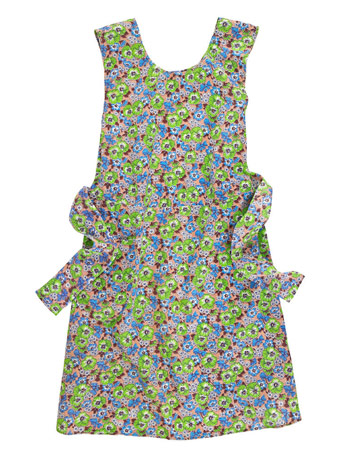
The baby is still asleep, but stirring, so Annie leaves the doors open as she returns to the kitchen. Taking a bright cotton apron from the back of a chair, she puts it on, then makes up some Lactogen formula for the baby, pouring it into the bottles she boiled up last night. One bottle is placed ready for when the baby wakes, the others go into a dish of water, covered with a wet towel to keep them cool.
She moves the saucepan of wheatmeal porridge from the hob where it’s been soaking overnight, to the hotplate of the stove for a final few minutes’ cooking before Fred comes in for his breakfast. She’ll need to stir it often so it doesn’t burn – burnt porridge is awful stuff to scrub off an aluminium saucepan, as she well knows. She makes coffee in the blue enamel jug, and sets it on the hob.
She makes a big pot of tea, too, as Fred is going to help his cousin Clarrie Deutscher move a mob of sheep down to WalWal today. He’ll need lunch, so she cuts some sandwiches, curling her lip at the white bread, which is all she has until she finds time to bake some proper wholemeal loaves. At least the butter is home-made. 
She fetches a leg of two-tooth from the Coolgardie safe, and cuts thick slices, layering them on the bread with home-made green tomato pickle – Fred’s favourite. She wraps the sandwiches and several pieces of boiled fruitcake in greaseproof paper, and packs them into the tin lunchbox. A couple of big glass bottles of cold, sweet tea complete the provisions.
Saving the porridge in the nick of time, she begins to serve it into bowls as she hears Fred’s booted steps on the back verandah. He brings in a zinc bucket of fresh milk, which he sets on the bench near the sink. They eat their porridge sprinkled with brown sugar and swimming in rich milk. 
Annie makes toast for Fred, pushing aside the stovewood to make a bed of coals. She uses the patent wire toastmaker with a long handle – the bread has a way of falling off the toasting fork. Spread with fresh butter, and honey from the big tin in the storeroom, even white toast is delicious. 
As they finish their coffee, a horn sounds outside, cousin Clarrie has arrived to pick Fred up. Stowing the lunch tin and bottles of  tea in a canvas haversack, Fred picks up his old felt hat and a jumper  and heads out to the gate, giving Annie a hug as he leaves.
Annie begins to stack the dishes in the sink, but before she can add water from the kettle, the baby wakes and starts to cry. Hurrying up the lino-covered hall to the bedroom, she picks the baby up from the big English pram where she sleeps, and carries her down to the warm kitchen. 
It’s now daylight, so she turns out the lamp and moves it safely away to the mantelpiece above the stove. She changes the baby and puts her in the wooden crib that Fred made while she mixes some Farex baby cereal in a small bowl. After spooning this into the small mouth, Annie sits down in the rocking chair, first dislodging the cat, to give the baby her bottle.
Baby is a slow and fussy feeder, and Annie reaches for the big green garden book she keeps beside the stove. She begins to dream of the wonderful garden she is making, with a little help from Fred, of course......

Saturday, September 3, 2011

Tanks for the memory


Aahhh! Rainwater, so pure and sweet, far better than what comes out of our taps today. Or is it? 
Maybe, if you have a modern tank, tightly covered and fitted with a strainer. But the old galvanised iron tanks of my childhood could be a bit dodgy. The welcome sound of rain on the roof could mean all sorts of stuff being washed into the tank – dust, leaves, bird droppings, dead insects.
Occasionally there was something bigger – hapless possums could fall into uncovered tanks. The story was told of a local hall where people complained that the tea at supper-time tasted odd. Sure enough, when the tank was inspected…Ugh!
In even earlier days, there were underground water tanks, built of brick rendered with cement. Water had to be retrieved with a bucket on a rope, or a hand-pump, laborious work. The water stayed nice and cool in summer though, and containers of milk and butter were often stored down there, to be hauled up when needed. No doubt a few fell in, too!
Over the years, a rainwater tank acquires a build-up of sludge in the bottom, which eventually has to be cleaned out. Watching this operation can be a bit off-putting – you mean we’ve been drinking THAT?
An iron tank that was starting to show a few leaks could be repaired by applying a patch - some material dipped in tar or thin cement – a piece of Dad’s old work trousers was good for this.

A tank could gain a new lease of life if the inside was concreted – first you lined it with wire netting, and then applied layers of concrete. Over the years these tanks sometimes acquired ‘stalagmites’ from seepage.
If you were flush enough to buy a new tank, the retired one was turned on its’ side and chocked with a couple of logs, to provide storage for firewood or stock food.
The tank was usually mounted on a timber stand, ideally of redgum to deter white ants. Otherwise they might munch away undetected for yers, until the inevitable happened and tank and stand came crashing to the ground.
Some people covered the tank stand with hessian or wire netting and grew creepers over it, and Mum’s precious collection of ferns found shelter there too.
 Nowadays you can buy a mighty fine tank of fibreglass or plastic, in a range of sizes and colours. And there’s provision for turning the first flush of rainwater away, until the roof is clean.
Modern tanks are mosquito proof too. Wrigglers in your glass of water are a bit of a turn-off – you could always strain them out of course (and we did!) and remind Dad to climb up and add a spoonful of kero to the water.
Surprisingly, this doesn’t taint the water; kerosine is a very thin oil, and just floats on top of the water.
Another water container must be mentioned, too – the canvas water bag. Once found on the bumper-bar, or the running-board, of every car, you wouldn’t leave home without it in the summer. Made of sturdy canvas, it kept your drinking water cool by evaporation from the damp surface of the bag. 
Water from a waterbag has a unique taste, but nonetheless welcome to a thirsty traveller.
Maybe our modern tap-water isn’t so bad after all…

Thursday, September 1, 2011

Bringing up Baby


I nearly didn't make it into the world at all. If it hadn't been for the skill and courage of a country doctor in Murtoa, neither Mum or I might have survived the birth.

Mum was 32 years old, small-boned, and carrying a large baby. As the hours passed, it became apparent that the labour was not progressing, the baby was not advancing down the birth canal, and the head was not properly engaged.
In short, I was stuck.
The doctor decided to attempt a 'high forceps' delivery, a highly dangerous procedure. Today the situation might be dealt with by Caesarian section, but this was 1940, in a small country hospital, ill-equipped to deal with major surgery. To the undoubted relief of all concerned, Mum was delivered of a nine pound baby girl, badly battered and bruised about the head, but alive.
Mum, who must have been pretty battered herself, nevertheless insisted that I should be baptised on the spot. (Catholics believed that children who die unbaptised cannot go to Heaven, but must remain in a place called Limbo until Judgement Day.)  She named me Marcia Imelda.
I was virtually unscathed by the necessarily rough treatment - some babies delivered like this can suffer brain injuries, but I have only a small bump on the right side of my head, and a tiny bald spot, to remind me of my narrow escape.
The doctor was Dr. S. Rabl, and Mum always spoke of him with great respect and gratitude.  Dr. Rabl was of German descent; his father, also a doctor, had come to Murtoa from Germany in the 1870s.
Once the drama of the birth was over, and Baby was pronounced out of danger, Mum could have expected to enjoy the rest of her 10 days'  'lying in period' - wearing her pretty bed-jackets and basking in the admiration and congratulations of visitors. Until it was noticed that Baby had developed not one, but two nasty abscesses in the folds of her fat little neck.
Baby was vociferous in her displeasure at this, but Dr. Rabl wouldn't let her go home until the abscesses were lanced, and showed signs of safe healing. There were no antibiotics then.
Finally the day arrived when we could go home. My parents had only a horse and buggy for transport back then, so Grandad Maher came down from Minyip to take us home in his car. On the way, he and Mum stopped in to register my birth - the certificate shows that it was September 11th, 1940. I was two weeks old, and I already had three permanent scars on my body.  Did Mum wonder "Whatever next?"
Mention might be made here of the prevailing attitude to the care and feeding of small children. Infant mortality was still high in the early part of the 20th century - and astonishing number of children died of diahorrea, and vaccination for childhood diseases was still in its infancy. Modern, ‘Scientific’ theories of child care were in vogue, with good reason and the best of intentions.
The guru of childcare was a New Zealander, Dr. Truby King, who believed and taught that babies should be treated and reared on the same strict regime that worked with farm animals, calves in particular. He published his book on childcare in 1910, and his teaching was still being followed in the 1940s. “Babies,” he said are “controlling and manipulative from birth, and it is necessary to teach them obedience by making them learn that crying will get them nowhere”. He considered it “a dangerous indulgence” to respond to a baby’s crying: “crying is necessary for health, essential exercise for the lungs”.
Dr. Truby King advocated feeding infants on a rigid, four hour schedule. It was thought that this allowed adequate time for digestion. (Some blame him for the steep post-war decline in breast-feeding.) No night feeds, strict routines of sleep, feeds and fresh air, and it was considered unnecessary to play with your baby. If babies did not sleep when they were supposed to, they were seen as trying to “manipulate and dominate their mothers.”
  State Governments had set up Infant Welfare Centres across the country, to educate mothers and monitor the progress of babies. These centres were run by trained Welfare Sisters, who weighed baby and counselled mother on the weekly visits. Many of the Sisters, though undoubtedly well intentioned, were martinets, who addressed their clients as Mother and Baby - "Baby doesn't seem to be gaining as much weight as she should." and  "Mother, you must make sure to keep to the proper routine."
Many mothers were terrified of them; it takes a good deal of confidence to disregard the 'experts' when your baby's wellbeing is involved. Poor Mum's anxious nature and nursing background made her a sitting duck for such as these, and added considerably to her distress when things didn't go as expected.
And they didn't. I simply didn't fit the mould. A large baby, I screamed for more food long before the four hours were up, and not getting it, I didn't gain weight as rapidly as I should have. All too soon, it was decided that my mother's milk 'didn't suit me' and I was put on a bottle. All those years ago, and I still get angry, just thinking about it! How must Mum have felt, to be told that her milk wasn't good enough?

Maybe just relieved, when the Lactogen that was prescribed seemed to satisfy my appetite, and I began to gain weight. And no wonder, Nestle's Lactogen was considerably higher in carbohydrate than breast milk, (not to mention the sugar that was added to the formula) without any of the benefits.


 All was peaceful for a while, but we weren't out of the woods just yet.
To be continued

Sunday, August 28, 2011

Keeping House

 Annie and Fred returned from their honeymoon to their new home at Lubeck, which they called “Kalang” – supposedly an Aboriginal word for beautiful.

They had very little money, and their furniture was either hand-me-downs from Annie’s family, or bought cheaply at clearing sales. The most valuable item was Annie’s piano, brought from the family home at Minyip. Mum told me that at first, they had a kitchen table, but no chairs – they sat on boxes.

One of the first things Mum did was to set up a Housekeeping Book – a small notebook where she kept meticulous accounts of every penny spent on housekeeping. She felt that, as Dad worked hard to support them, he was entitled to know exactly where the money went. 

She kept up this habit for many years – I have three of these little books, dating from 1939 to 1956 – and they make fascinating reading.
The main management of their affairs she left to Dad - she explained that he was rather diffident about financial matters in those days, and she wanted to show her confidence in him. A decision that would later come back to bite her, as we will see!

The first book begins on February 1st, 1939, and records, in tiny writing, purchases of bread, meat, salad vegies, fruit, - and the Womens’ Weekly, which cost fourpence!

Before long, there was some income, too, from the sale of butter and eggs, occasionally skins – probably rabbit. Rabbits were a great pest, and when shot, the skins were stretched over an oval frame of stout wire, and hung up to dry. Then they were sold to a skin dealer, and presumably ended up as felt hats.

My parents always kept a cow – or two or three - and the milk was separated, the cream either sold to the butter factory in Murtoa or made into butter at home, and sold to the local store. There was a covered stand for cream cans at the front gate of most farms, and a truck would pick them up, returning the empty cans. Most farmer’s wives made some extra income from cream or butter, and the money was usually considered to ‘belong’ to the wife – who had, after all, milked the cows and washed the separator!

The farms was 640 acres in size, most of it used for grazing sheep – Dad never grew wheat there. He earned some extra income working for his cousin, Ernie Niewand, who had land to the south of Lubeck, and Dad helped with moving flocks of sheep, and also in the shearing shed.
 
But the main farming activity was Dad’s passion – poultry. Beginning with a small shed and a few hens, he gradually built up the flock until he was able to send boxes of eggs on the train to Stawell, and eventually established a hatchery for day-old chicks, also sent off by rail. Dad loved his chooks, and would continue poultry farming for most of his life.

He kept ducks, too, there are entries for the sale of ducks and drakes in the housekeeping book. Some of these would have been sold as breeding stock, but most were ‘dressed’ by Mum, destined for a neighbour’s table.

Dressing poultry is an art – dunking the bird in boiling water for just long enough to loosen the feathers, plucking it, singeing it over a flame to remove any ‘whiskers’, drawing out the innards and cleaning it, then trussing it neatly, ready for the oven. The  gizzard and giblets, and possibly the feet, would be saved for soup. As a farmer’s daughter, Mum was adept at all this, but it was far from her favorite task. Though she said turkeys were worse.

Before long there was a vegie garden , supplying the house, and occasionally some surplus to sell. But water was limited, the house was supplied by rainwater tanks, and there were several dams, fed from a water channel snaking across the country from a reservoir in the Grampians. 

There were two rainwater tanks on the south side of the house, and also an underground tank in the garden. Once, during a thunderstorm, the sudden rush of water was too much for an old & rusty tank, which collapsed – my sister and I thought this very exciting, but Mum cried – all that precious water wasted! To this day, I can’t bear to see a dripping tap.

The housekeeping books continue through my childhood, documenting our move to Geelong, and later to Central Victoria. Mostly in Mum’s handwriting, occasionally in Dad’s, they record the minutiae of daily life – torch batteries and toothpaste, singlets and swimsuits; a unique account of my family’s history.

Wednesday, August 24, 2011

Milady's dressing table

Today I'm sharing some pieces from my collection of family memorabilia. Among the plethora of embroidery and crochet our foremothers made were Duchesse sets, to decorate and protect the dressing table.


Older dressing tables were often quite elaborate, with three-level tops and large bevelled mirrors. So the Duchesse set would consist of a large central piece and two side pieces, like this one from my mother's trousseau.

On the dressing table you might find a pincushion topped with a china half-doll like these,


or perhaps a bakelite box of dusting powder.


The little top hat beside it covers a bottle of "Mischief" perfume.


The tortoiseshell tray most likely held a man's brushes, with collars studs being kept in the little round box.


The round powder bowl is particularly beautiful, so thin it's almost transparent, with the cutest little green feet underneath.


If you have any pieces like this, take care of them, they are quite fragile.


Sometimes a lady might feel the need for some Sal Volatile, best keep it handy on the dressing table.

Sal volatile, or smelling salts, were widely used in Victorian Britain to revive fainting women, and in some areas constables would carry a container of them for this purpose. The use of smelling salts was widely recommended during WWII, with all workplaces advised to keep ‘sal volatile’ in their First Aid boxes.
They work by releasing ammonia gas, which irritates the mucous membranes of the nose and lungs, triggering an inhalation reflex, thus causing the muscles that control breathing to work faster.
(I don't think Mum ever used it.)


The other two are perfume bottles - "Divinia" by F.Wolff & Sons, Germany; and "Phul-nana", a very popular oriental-style perfume. I remember Mum wearing this when I was small.

Sunday, August 21, 2011

A marriage of two cultures

When my parents, Annie Maher and Fred Niewand, were married in January 1939, two important threads in the fabric of European Australians were woven together. Annie’s forbears were pure Irish, devout Catholics, and in Annie’s day, unaware of their convict ancestry. Fred was descended from German stock, who were miners in their native Harz Mountains of Hannover, and devout Lutherans.

The marriage was not blessed with the approval of either family, for both were "marrying out" and this was frowned on, especially for Annie, as marriage to a non-Catholic was considered a grave risk to the Faith.

Fred was of blameless character, and generally liked, but ... he wasn't a Catholic. In order to be married in Annie's church, it was necessary for him to undergo a course of instruction in the Catholic faith, and he had to solemnly promise that all their children would be brought up as Catholics.

The parish priest in their hometown of Minyip refused to marry them at all, so they were married at St. Patrick's Cathedral in Ballarat, (though only in the vestry).

Though no longer a Lutheran himself – he was nominally a Presbyterian - Fred had declined to convert to Catholicism. Mum said the practice of confession to a priest was his stumbling block. He always accompanied us to Midnight Mass at Christmas, and attended our First Communions and Confirmations, but otherwise he stayed home, though he spared no effort to see that Mum was able to attend Mass - the car was always ready for her on Sunday mornings, in good order.

Annie endured a good deal of discouragement from her family before marrying Fred, and must have thought long and hard about it; perhaps that's one reason why they waited so long to marry ( she was 30, he was 33) though there was also the question of money, waiting until Fred could afford a farm of his own. Eventually a farm at Lubeck, about 30 miles to the south of Minyip, was bought from Fred's uncle, Ernie Niewand.

Annie’s only supporter as she prepared to marry Fred was her Aunty Belle, her mother’s sister, who was herself happily married to a Protestant, and wrote several warm and encouraging letters to Annie. Annie’s own mother had died in 1927, and Belle had been a friend and mentor to Annie as she was growing up.

Dad’s family were probably not thrilled either, but seem to have been friendly enough once the deed was done, and Mum’s relatives got over it, too.

It was a very quiet wedding, I don’t think Mum told anyone the date beforehand, although they had been given a “kitchen tea” some weeks earlier. Perhaps their friends were not as prejudiced as their families. The only relatives present were Annie's father, Pat Maher, and her brother Jack.

Unlike her sister Eileen, who had married a few years earlier, Annie didn't wear a white wedding dress. Instead she chose a "costume" of soft mushroom pink crepe.
I still have the gloves she carried that day, and a fragment of the dress. It was made by a dressmaker, and you can still see the faint pencil marks where the beads were sewn on. One tiny bead remains.


Footnote: I've never had any trouble remembering the date of my parents' wedding, because the next day was Black Friday, when Victoria was devastated by catastrophic bushfires.
There had been a long drought, and a series of heatwaves. Creeks and rivers were dried up, and people living in Melbourne were on water restrictions. (Sounds familiar, doesn't it? But remember: this was 1939, the population was much smaller, and firefighters had virtually no equipment)
Fanned by strong winds, the bushfires swept across large areas of Victoria at horrifying speed, causing much destruction.
Almost 2 million hectares were burnt, whole townships destroyed, and 71 people died.
This disaster led to the formation of the CFA in 1944.